
Revenue Coaching Framework
When a commercial result or KPI needs attention but the cause is not clear, the first step is diagnosis — not automatically training or coaching.
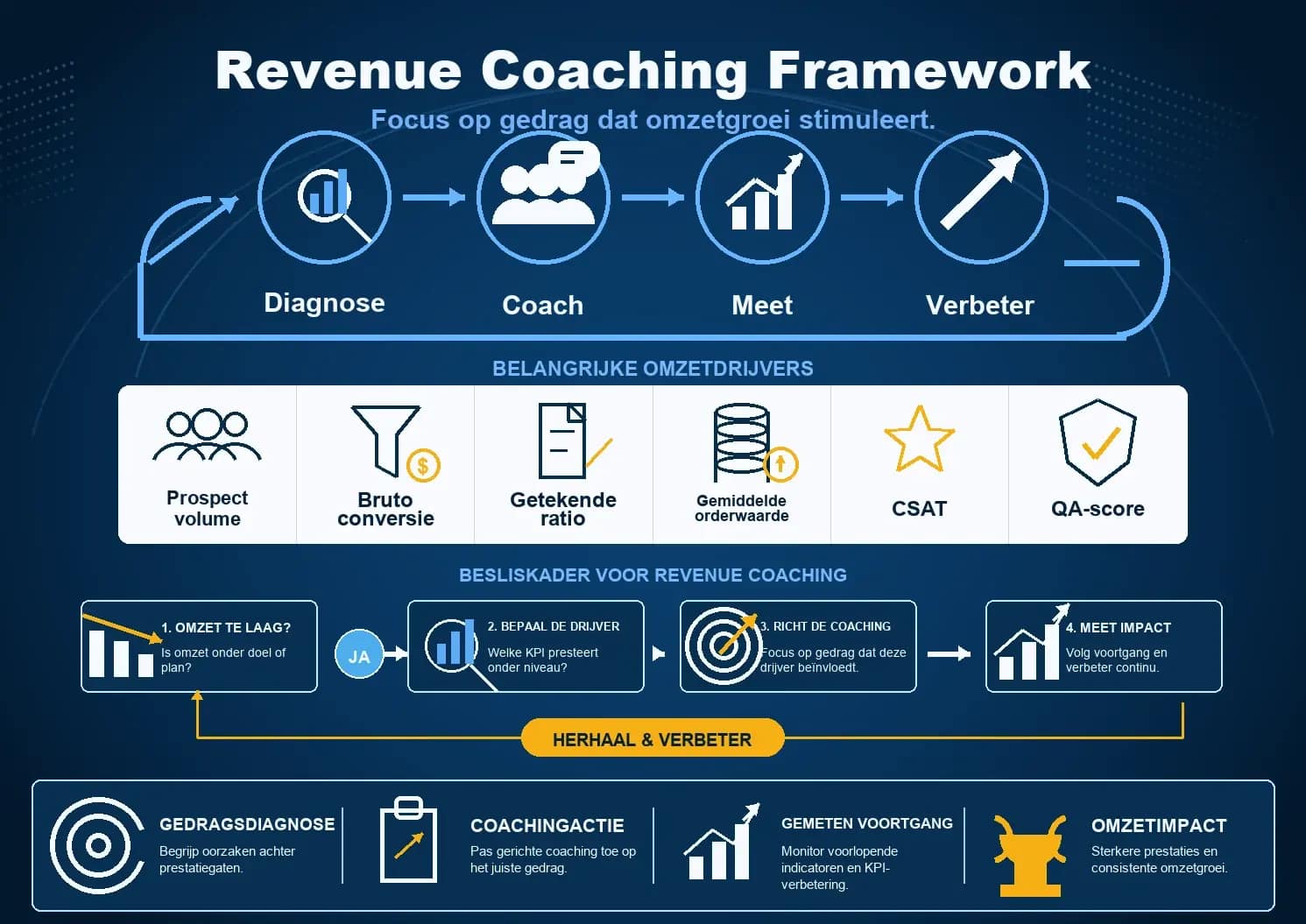
The framework connects the commercial signal to practical evidence, diagnosis and one focused coaching action.
Four steps from signal to action
The framework connects data with practical evidence before a coaching action is chosen.
Which commercial result or KPI needs attention, over which period and in what context?
Which calls, CRM notes, opportunities, handovers or manager observations help explain what is actually happening?
Is the main development opportunity in behaviour, skill, knowledge, process, tools or manager support?
Choose one influenceable behaviour or one focused intervention and agree how application will be followed up.
Which signals can prompt an investigation?
The framework can be used when a commercial result needs attention but the cause is not yet clear.
Pipeline development
For example, when activity, meeting quality or pipeline volume falls behind.
Discovery and qualification
For example, when opportunities are qualified too early or too late.
Value communication
For example, when proposals lack differentiation or value is not discussed clearly enough.
Deal progress
For example, when opportunities stall or next steps are not sufficiently clear.
What the framework prevents
The aim is to prevent commercial figures from being translated too quickly into a training or coaching solution.
KPI = cause
Low conversion shows that something needs attention, but not why.
Training as the default answer
The right intervention may be coaching, training, a process change, tools or manager support.
An overly broad coaching focus
The framework keeps the action small: one relevant behaviour or one clear intervention per cycle.
Results without context
Market, proposition, lead quality, processes and systems remain part of the diagnosis.
Where is the framework used?
Sales professionals
To translate commercial signals into one specific development point in day-to-day practice.
Sales managers
To use KPIs as a starting point for better call reviews, pipeline coaching and one-to-ones.
Sales Enablement
To determine whether coaching, training, processes, tools or manager support is the right intervention.
Further exploration of interpretation and progress
Results & ROI
For careful interpretation of behaviour, application, indicators and broader results.
Measuring Progress
For practical tracking of a chosen development across several moments.
Which commercial signal do you want to understand better?
Briefly describe which result or KPI needs attention and what practical information is available.